A European Testbed for Digital Water Innovation
During its second pilot iteration, the WATERVERSE project demonstrated how a common Water Data Management Ecosystem (WDME) can transform the way water utilities and authorities manage, share, and use data.
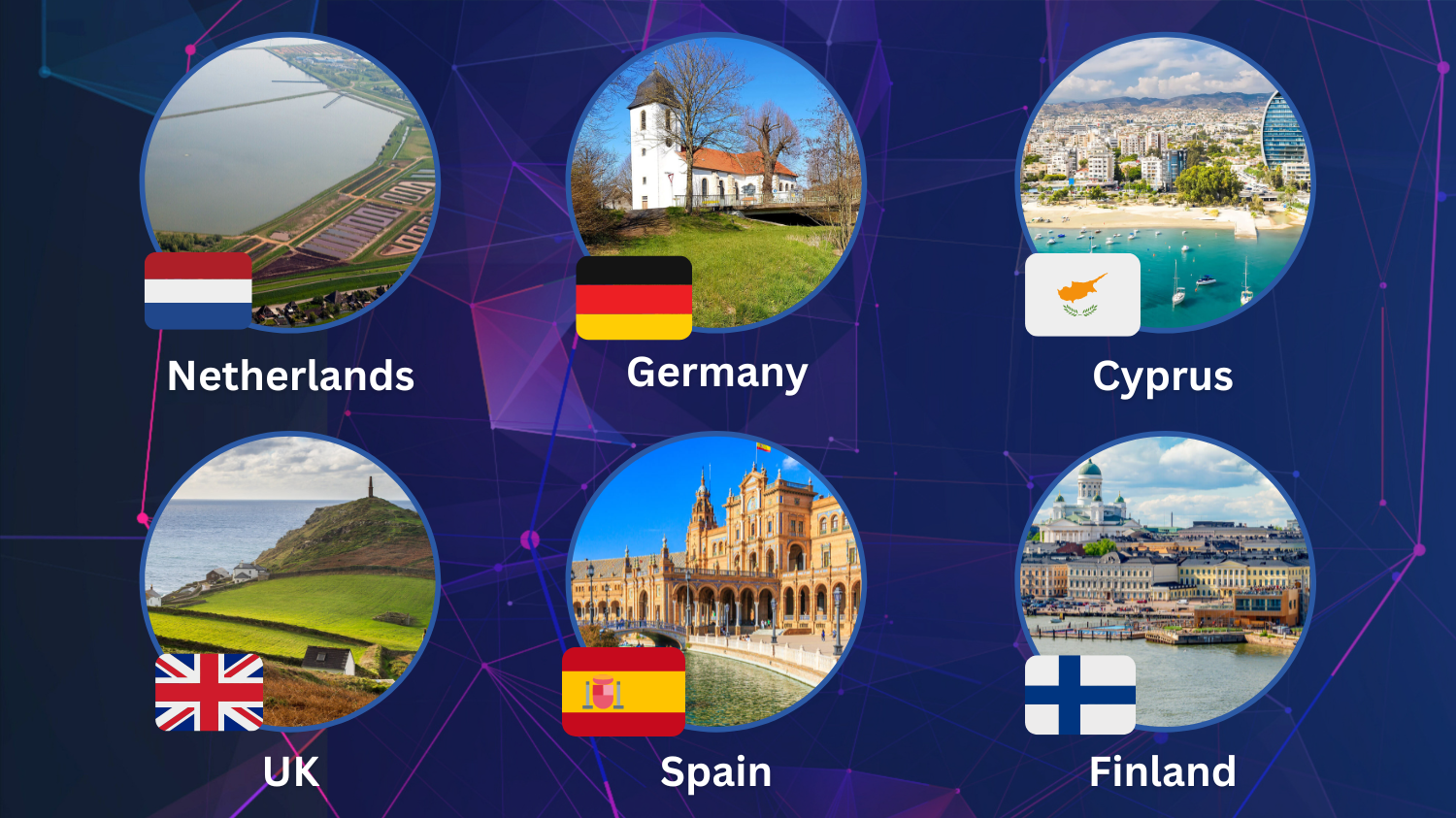
Six pilot sites across Europe (in the Netherlands, Germany, Cyprus, the United Kingdom, Spain, and Finland) validated the WDME as a modular, interoperable and secure environment for integrating data, running analytics, and supporting decision-making.
Summary descriptions of pilots
- Netherlands: Smart water quality and chloride monitoring
The Dutch pilot applied the WDME to integrate in-situ and satellite data for chloride concentration forecasting. The system simplified data workflows, reducing manual work by up to one-third, and enabled faster, more accurate water-quality assessments.
- Germany: Flood risk prediction and early warning
The German pilot used the WDME to consolidate flood-sensor and hydrological data, improving preparedness and emergency planning. Municipalities gained faster access to reliable data for risk evaluation, helping protect infrastructure and communities.
- Cyprus: Digital Twin and system management for utilities
In Limassol, the WDME was deployed as the backbone for the city’s water network digital twin, integrating telemetry, smart meters, and satellite inputs. It improved operational transparency and governance awareness, while sparking a national discussion on data-sharing frameworks.
- United Kingdom: Anomaly detection and water quality prediction
The UK pilot, led by the University of Exeter and South West Water, demonstrated AI-based anomaly detection at the Crowndale Combined Sewer Overflow (CSO) site. The WDME enabled multi-source data integration and facilitated the identification of many events, improving data quality and supporting predictive models for river water quality.
- Spain: Climate resilience and data reuse in urban water management
Coordinated by Cetaqua and Hidralia, the Spanish pilot validated the WDME for managing climate-resilience and water-reuse datasets. Utilities improved visibility over consumption patterns, optimised resource allocation, and engaged municipalities and academia in collaborative governance.
- Finland: Automation and interoperability across utilities
The Finnish pilot, led by VTT and Keypro, automated data conversion and quality assurance tasks, reducing processing times from hours to minutes. The WDME’s integration with the KeyAqua platform proved its scalability and suitability for shared infrastructure models among Nordic utilities.
Lessons Learnt from the Feedback Collection
Feedback from more than 100 users, engineers, and observers across the pilots highlighted several key insights for large-scale adoption of digital water ecosystems:
- Ease of use is critical for adoption. Over 85% of users rated the WDME as easy to use, with training and support playing a decisive role.
- Automation delivers the fastest gains. Automated data flows and validation tools consistently produced time and cost savings across pilots.
- Interoperability must go hand-in-hand with governance. Technical standards such as NGSI-LD, FAIR, and OGC solved integration challenges, but long-term use depends on clear data-sharing and procurement rules.
- Procurement guidance accelerates uptake. Some utilities requested a practical roadmap, describing how to phase in WDME-compliant tools, a model now recommended by the project for other public authorities.
- Human capacity and collaboration are as vital as technology. Multi-Stakeholder Forums built trust, shared knowledge, and connected utilities, researchers, and policy-makers around the same goals.
These lessons are now being transformed into practical recommendations and procurement-support materials within the technology exploitation perspective, ensuring that the project’s experience directly informs future exploitation and market uptake.
Results of the Pilot Process
The pilots proved that WATERVERSE’s open, standards-based approach can work across very different contexts, from small municipal utilities to large national operators. Evaluation highlighted the following impact dimensions:
– Operational efficiency: Faster, simpler, and automated workflows; reduced manual effort by up to 70%.
– Economic impact: Time and cost savings through automation and shared data infrastructures.
– Environmental benefit: Enhanced monitoring, predictive management, and sustainable resource use.
– Social / Organisational: Strong stakeholder collaboration and awareness of data governance.
According to the project’s Business Plan and Sustainability, these outcomes validate the WDME’s commercial and policy potential. The ecosystem can be adopted under different models, from shared digital infrastructure among utilities to service-based offerings by technology partners, ensuring that the project’s impact continues beyond its lifetime.
A European Legacy
With all six pilots achieving their KPIs, WATERVERSE has proven that Europe’s water sector is ready for data-driven transformation.
The WDME now stands as a tested foundation for future Water Data Spaces, enabling transparent, interoperable, and sustainable digital water management across Europe.